About This Session
Your institution has a strategic plan. Your IT team is executing projects. The gap between them — ungoverned, invisible, and growing — is exactly what Digital Campus Management (DCM) was built to close. At Trinity University, DCM is a digital stewardship concept formally embedded as Initiative 3.4 of their "Ready Set Rise" strategic plan.
This session presents the practitioner story of building DCM from the ground up: a university-wide governance framework organized across four strategic focus areas, with committees that draw membership from across the entire campus — faculty, staff, students, and departments spanning academic affairs, institutional research, finance, and beyond.
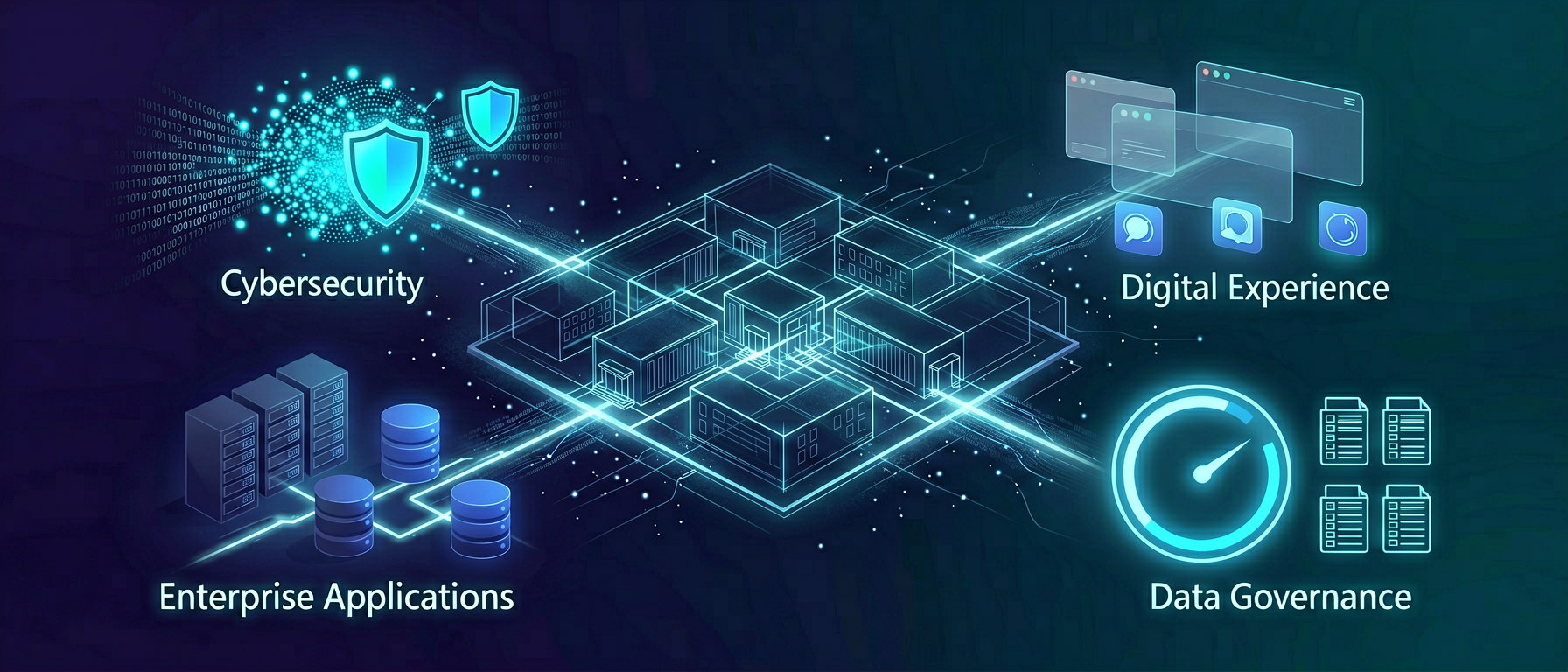
The Four Focus Areas
Cybersecurity
How technology is secured — addressing threats, compliance, and institutional risk posture.
Digital Experience
How technology is experienced — user-facing platforms, accessibility, and service design.
Enterprise Applications
How technology is operated — ERP, SIS, integrations, and the core administrative stack.
Data Governance
The deliberate fourth addition — the connective tissue that keeps the other three areas coherent. Chaired outside ITS by Trinity's Executive Director of Institutional Research.
How It Was Built
- Phase 17-Month Quiet Phase — Internal alignment before any public rollout, using a Crawl/Walk/Run change management strategy
- Phase 2Two-Tier Roadmap Design — A public Strategic Roadmap paired with internal Tactical Roadmaps for each focus area
- Phase 3Five-Stage Intake Funnel — Moving ideas from any campus stakeholder through triage, PMO assessment, focus area review, and DCMO authorization
- FrameworkDecision Quality Framework (DQF) — Four gate reviews with go/no-go authority, fully methodology-agnostic (waterfall, agile, scrum, or hybrid)
Learning Outcomes
- Describe the Digital Campus Management framework architecture and how its four focus areas create a coherent digital stewardship system.
- Identify the organizational and political conditions required to successfully launch a university-wide IT governance framework at a small liberal arts institution.
- Apply the DCM intake funnel, roadmap design, and charter templates — all available for direct adaptation — to initiate or advance governance at your own institution.
Session Description
This session tells the practitioner story of DCM, including how a Crawl/Walk/Run change management strategy sequenced a 7-month internal alignment phase before any public launch, and how the Decision Quality Framework provides strategic governance while remaining methodology-agnostic below — accommodating waterfall, adaptive, scrum, and hybrid execution without requiring institutions to change how their PMs work.
All framework artifacts — intake funnel, charter templates, roadmap structure, and Crawl/Walk/Run OCM design — will be available to attendees for direct adaptation.